Bench
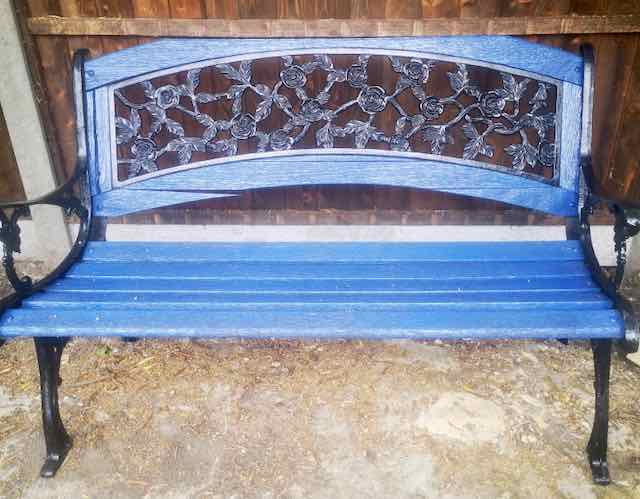
I painted the bench that I kept intending to chuck out but never did. I looks nice. I intended it to be a deeper blue, but in Homebase your knowledge of the colour inside a tin is limited to the small swatch on the label, which are often misleading. So I might take it a shade darker, but I’ll wait until the turf is down, so I can see the colour in the context. This blue might look amazing against a sea of green.
July reading
Just finished:
- The making of Mike Oldfield’s Tubular Bells, Richard Newman
- Rialto 96
- The Nanny State Made Me, Stuart Maconie
- Racing Hard, Willian Fotheringham
- The Shropshire Lad, AE Housman
- Hotel insomnia, Charles Simic
On the go:
- Word Perfect, Susie Dent
- Selected Poems, Tony Harrison
- A Taste for Death, PD James
- The Crucible, Arthur Miller
- The Left Hand of Darkness, Ursula K Le Guin <- course recommended reading
- The Writer’s Voice, Al Alvarez <- course recommended reading
Recently acquired but not started:
- Why Women Will Save the Planet, Friends of the Earth and C40 Cities
- Tenth of December, George Saunders <- course recommended reading
- Too Much Happiness, Alice Munro <- course recommended reading
- Other Stories and Other Stories, Ali Smith <- course recommended reading
- The Birds & Other Stories, Daphne du Maurier <- course recommended reading
- The Misunderstanding and Caligula, Albert Camus
- Bar Mitzvah Boy and Other Television Plays, Jack Rosenthal
- The Adventures of Tom Sawyer, Mark Twain
- The Invisible Man, HG Wells
- Going to Meet the Man, James Baldwin <- course recommended reading
- Young Skins, Colin Barrett <- course recommended reading
- Omeros, Derek Walcott <- course recommended reading
The New Shed

I built a shed. By ‘built’, I mean I bought it in bits and fastened it together, like an Ikea wardrobe but for outdoors. Still, I got pretty handy with the drill, and I did a fine job making a base from that old path I mentioned several posts ago, (you remember the one! the one about the path!) And I’d never put felt on a building before, so that was something of a learning curve.
Top marks to the shed people, they included more of everything I needed when it came to screws, felt tacks, etc, which was brilliant because I could make mistakes or drop them and lose them in the soil, and it wasn’t an issue.
When I lay a new path down the house return, I’ll use the same tiles to make the shed base a little less raggedy.
So now, I need to put stuff in it. It’s going to be a convenient dumping ground for anything we *don’t* want in the house or in the summerhouse. Which is good, because it will give us more space to play in.
And I have a shed.
Beginner books for the Raspberry Pi
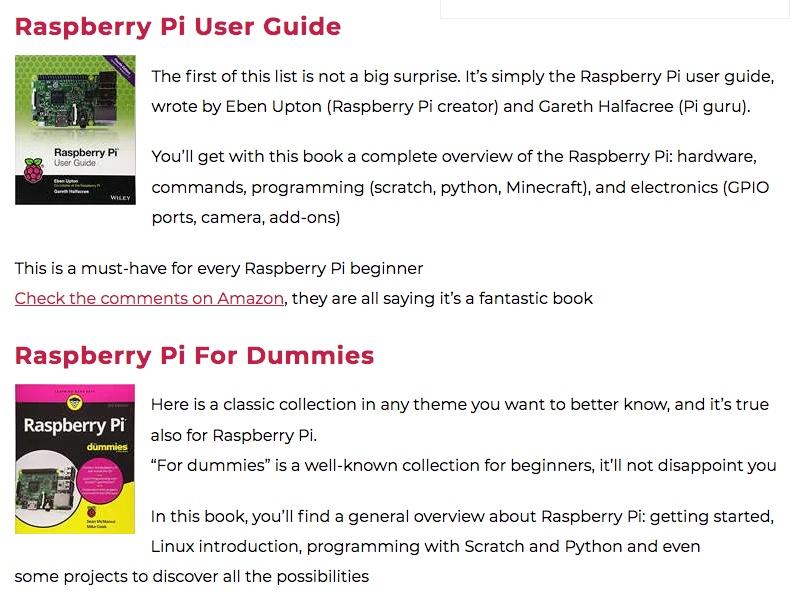
I’m proud to say I commissioned three of these twenty beginner books about how to use the Raspberry Pi. It feels like a long time ago:

Including the first two:
Notes on Life Studies
Life Studies, by Robert Lowell, is recommended reading on my course.
- I’ve known of Robert Lowell for a long time, though I don’t recall reading any before. I might have read Skunk Hour in an anthology but, if I had, I’d forgotten the nature of it. I knew it was about some middle-aged man snooping around the cars of courting couples, but that was all.
- Life Studies is his most famous work. I didn’t care for it. Sorry, Robert.
- His poems were hard work, and didn’t offer any real insight once I’d gone to the trouble of trying to understand them.
- I understand that his poetry was part of an important movement in American poetry. The writing was a step away from the more formal, form-based poetry that came before it. In that sense, it lay the groundwork for many poets that came later, such as Robert Creeley, John Ashbery, etc. (I might have my chronologies wrong, but never mind).
- His work, so far as I understand it, is championed because of its autobiographical nature. Fair enough. I still didn’t care for it.
- There were lots of poems which had a historical perspective. They didn’t add up to much.
- The middle section of the book is a long prose poem.
- His prose is turgid.
- The story he told was uninteresting.
- I should be more analytical about what wasn’t working, but I’ve no interest in analysing his work. I’d rather read something else that interests me. The lesson I take away is, you can talk about big, interesting, vital topics, but you have to use language in a way that excites or interests the reader. Otherwise, they aren’t going to bother. Why should they, when there are a million books out there that are waiting to be read.
Which leads me to the following thoughts:
- You can edit life out of your text, or you can edit life into it.
- Personally, the first draft is just something I want to get down on paper, so I can say it exists.
- After that, that’s when the real work begins. I’ll take that first draft and work it again and again until it forms the shape I want it to form. In that sense, I work like a sculptor of clay, starting with a basic shape that kind of resembles the thing I’m after, and I keep working on it, getting it a little bit closer on every iteration.
- A good editor, like a good translator, can enhance your work. It’s hard to edit your own material, but still, you’re the one who knows what you want it to be once it’s done. You can’t delegate that.
A round-up of my reading, H1 2021
Here’s a list of all the books that I’ve associated with over the last six months, (in roughly the order I read them).
Finished:
- The Mountains According to G, Geraint Thomas
- Twilight of Democracy, Anne Applebaum
- Autumn Journal, Louis MacNeice
- This Sporting Life, David Storey
- Happy Birthday, Wanda June, Kurt Vonnegut
- How Sweet It Is, Lamont Dozier.
- The Crime Writer’s Handbook, Michael O’Byrne
- 218 Facts A Writer Needs To Know About The Police, Kevin N Robins
- Starstruck, Val McDermid
- The Air Year, Caroline Bird
- Galapagos, Kurt Vonnegut
- God Bless You, Dr Kevorkian, Kurt Vonnegut
- Joe Kirby: King of Comics, Mark Evanier
- Ella Minnow Pea, Mark Dunn
- White Bicycle, Joe Boyd
- Nick Drake, Patrick Humphries
- Capitalism: 50 Ideas You Need To Know, Jonathan Portes
- Exercises in Style, Raymond Queneau
- Antarctica, Clair Keegan <- course recommended reading
- Lumen, Tiffany Atkinson
- The Iron Man, Ted Hughes
- Life Studies, Robert Lowell <- course recommended reading
- The Good Ancestor, Roman Krznaric
- In Praise of Men and Other People, Ann Sansom
- Come Closer and Listen, Charles Simic
- Exit Management, Naomi Booth
- First Person Singular, Haruki Murakami
- Ambit Pop
- The Little Black Book of Data and Democracy, Kyle Taylor
- Ministry for the Future, Kim Stanley Robinson
- The Illustrated History of Football, David Squires
- Ways of Seeing, John Berger <- course recommended reading
- Lunch Poems, Frank O’Hara <- course recommended reading
- Two Days in Yorkshire, Peter Cossins and Andrew Denton
- The Unaccompanied, Simon Armitage
On the go:
- Word Perfect, Susie Dent
- The Nanny State Made Me, Stuart Maconie
- Racing Hard, Willian Fotheringham
- Selected Poems, Tony Harrison
Acquired but not read
- Notes of a Native Son, James Baldwin
- Pity the Reader, Kurt Vonnegut
- Writing Poetry, Peter Sansom
- Careful What You Wish For, Peter Sansom
- Children of Men, PD James
- A Question of Blood, Ian Rankin
- There and Back Again, Don Letts
- How to be a Liberal, Ian Dunt
- London Incognita, Gary Budden
- The Secret Barrister
- The Creative Writing Coursebook, Julia Bell and Paul Magrs (ed)
- The Echo Chamber, Luke Williams
- The Unfolding of Language, Guy Deutscher
- The Blizzard 50
- The Artist and Writer’s Yearbook 2021 (a pressie – very kind indeed!)
- Why Women Will Save the Planet, Friends of the Earth and C40 Cities
- Rialto 96
- Tenth of December, George Saunders (Father’s Day pressie – thanks!) <- course recommended reading
- Too Much Happiness, Alice Munro (Father’s Day pressie – ta!) <- course recommended reading
- Other Stories and Other Stories, Ali Smith (Father’s Day pressie – merci!) <- course recommended reading
- The Birds & Other Stories, Daphne du Maurier (Father’s Day pressie – muchos gracias!) <- course recommended reading
- The Shropshire Lad, AE Housman
- The Misunderstanding and Caligula, Albert Camus
- Bar Mitzvah Boy and Other Television Plays, Jack Rosenthal
- The Adventures of Tom Sawyer, Mark Twain
- The Invisible Man, HG Wells
- Hotel insomnia, Charles Simic
- —–> (I’m sure I’ve missed some. Ah well!)
Bought for my wife:
- AOC: A Celebration of the Fierce Brilliance, Lynda Lopez
- Jacinda Ardern: A New Kind of Leader, Madeleine Chapman
- Ruth Baden Ginsberg, Jane Sherron De Hart
Notes on Antarctica
Antarctica, by Clare Keegan, is recommended reading for my course.
- I hadn’t read any Clare Keegen before.
- She writes wonderfully well. Her prose is lovely.
- Her writing reminds me of Raymond Carver. Elegant, elegiac short strories, generally about a turning point in a working class person’s life.
- The stories are usually set in rural environments, many of them on small-holdings.
- I couldn’t work out where she was writing about: Ireland; Irish enclaves in southern USA; etc. That’s not a criticism, just an observation.
- She writes of working people and working lives with incredible attention to detail. It’s awe-inspiring. I wondered if it was a product of a life lived in those circumstances, or flawless, diligent research. Or both.
- This is the kind of thing I should look up, though to some extent, it doesn’t matter: the prose comes across as authentic. I believe her when she describes the location, the setting, the culture, the work practices.
- There’s a nice breadth to her story-telling, though mainly she talks about the sadness endemic to women’s lives. She talks about their resilience, too.
- So these are stories which reflect the experience of women. Though the settings are rural, there’s a universality about the experience which I am sure echoes in the lives of other women.
- There’s a story at the beginning where a woman seems to be being punished for her independence, for acting on her impulse. Everything turns to crap for her.
- I worry about stories where everything is crap.
- I know there’re a lot of crap situations out there. I/we know about them. We see them every day on the street, on the news. The trick is to acknowledge that, then find a way to represent the beating heart of humanity in a way that’s feasible.
- Anyway, I worried that all the stories were going to be like that. It gave me the impression that I wouldn’t like this collection.
- I need a bit of hope in the stories I read, not just despair. This might just be me, being a wimp.
- But then, not all the stories were like that. Many showed tough women, making the most of situations which were not of their choosing.
- Often, the situations are crap because the men in their lives are unpleasant, self-serving, greedy.
- As a man, I have no problem with men being represented like that. This is one woman’s view of the world. I don’t doubt that she is writing about men according to her experience. If that’s the case, men have a lot to answer for. It’s up to me and other men to learn to be better.
- In that sense, these serve as cautionary tales for the men who read them.
Trench
The electrical cables, which run to the summerhouse, need to be buried. They need to be two feet deep, where they won’t be accidentally sliced should a mechanical digger happen by. Which means I have been digging a trench. Which is hard work for a penpusher.
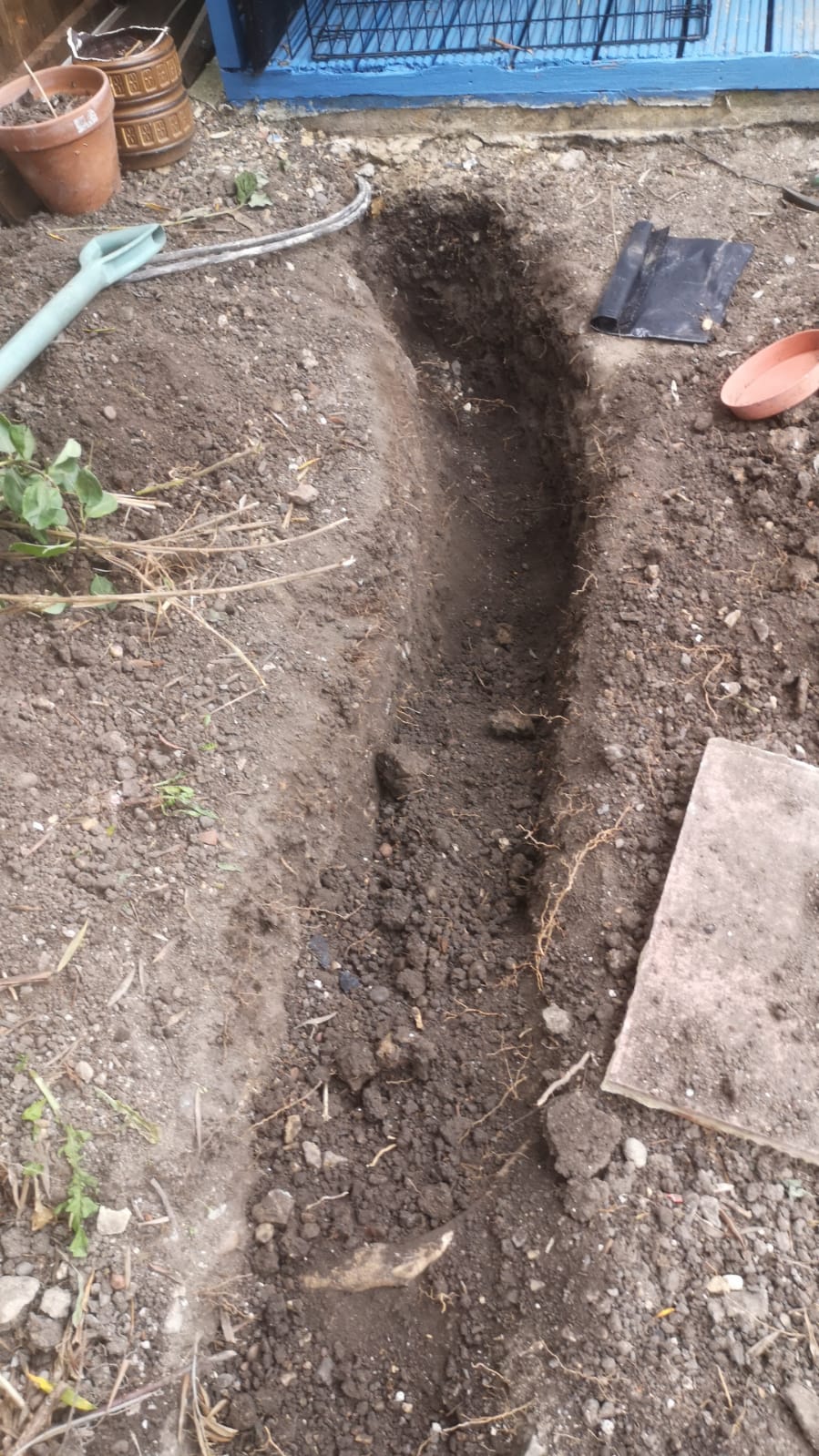
I can use some of the soil I’m digging up as top soil. When I refill the trench, I’ll lay a bottom layer of concrete rubble, which will help with drainage, and which will give me two or three square metres of soil.
At some point, someone has buried a lot of bottles in the garden. I’m having to lift the broken fragments out, bit by bit. And someone has left a dog in the trench, too:

World Cup 2010: England Were Found Out
I wrote this in 2010 after watching the Men’s England-Germany game in the World Cup. I never quite finished it, so I never quite posted it. I’m reading it back the day before England play in the Euro 2020 final against Italy.
I made some good points! Maybe that wasn’t unusual. I suspect a lot of people were thinking the same thing. MA lot has changed over the last eleven years. So here’s my original piece, annotated with hindsight:
——–
I watched the England-Germany game in a hotel room in Paris. I like watching games on my own. I liked having French commentary I didn’t understand as a soundtrack. I got to make up my own mind about England’s defeat.
I still like watching games on my own. And, other than the names of the players, I rarely pick up anything from the commentary that I can’t see for myself. I once watched Rangers versus Raith Rovers play in the Scottish League Cup final on BBC Alba, where the commentary was in Gaelic. I liked the excitement in the commentator’s voice, but lost nothing in terms of information. The other day, driving back from Timber, we listened to the England-Ukraine game on the radio, it struck me that I only knew what the commentator told me. If he didn’t mention Phillips, say, I had no idea what kind of game he was having. I found it very frustrating.
By and large, England were awful. I don’t think Germany were that great, but they ripped apart a shoddy defence, and put the ball away very well indeed. They’d watched us, and they’d worked us out. They had a game plan to take advantage of our many weaknesses, and they were disciplined enough to follow it through.
We never asked questions of them. We had none of the movement that we are used to Rooney, Gerard, Lampard etc making when they play for their clubs. We were prosaic, obvious, static and we banked on long shots when we should have been trying to pick them apart. They had centrebacks who didn’t allow us to turn, which wouldn’t have been a problem if our midfielders had been running on to feed off the strikers. Our forward line was so isolated that the Germans could get two or three men around the ball to snuff out runs and swifter passing. And we panicked: when our goal was disallowed, we punted the ball desperately forward instead of keeping shape and trusting that we were good enough to find a way through. Our defenders pushed on, seeking a goal, and left massive gaps at the back.
There are times when this still happens to England. The easiest way to get the ball from us is let us play it out from the back: have your strikers close our defenders down, our defenders invariably push the ball back to our keeper, the keeper invariably blasts it down the pitch, your defenders invariably win the header, nod the ball down to your midfielders, and the ball is yours to do what you want with it. Sometimes, we’re still too static. The midfielders hide behind their markers, rather than moving into space and calling for the ball. Sometimes, I don’t get the sense they know where their next pass is before they receive the ball. We’re easy to play against.
But other times, when this England team play with energy and imagination, everyone is moving, everyone is calling for the ball, everyone has options for the next pass, the front four/five are getting it into feet and turning and running with the ball, or are playing delicate, precision balls into space, or are taking a shot. We’re attacking from *everywhere*, so the defence doesn’t know whether to drop back or to close us down, and we make plenty of chances, and we have quality forward players who can put the ball away. We can be exhilarating.
We don’t think about our football. We believe blood and guts will win the day, but it never has. We need to analyse the game, every player, all the time. Quoting Henry V, or whoever, isn’t going to win it for us.
“We need to analyse the game, every player, all the time.” I get the sense that this group of players does that. Or at least, enough of them to make a difference to the way we play.
And I’ve thought long and hard about how culpable Cappello is in this. And really, I don’t think he helped matters. How do you coach a player about the weaknesses of an opponent if the player doesn’t know they are playing till two hours before kick-off? Why not sit down with them two days beforehand and show them videos: ‘look, they always do this, be aware of it, exploit it’. A player can be both hungry and tactically aware. Is the attacker they are marking predominantly right- or left-footed (I’m still stunned how many players at the highest level are one-footed)?
There’s a huge difference in the ways Capello governed the team and Southgate’s coaching style. Capello was the patriarch who didn’t engage with his players. I’m sure there are times when that style worked, but not any more. Kids don’t grow up that way. They expect to be treated with respect, and they give it back when they receive it. I’ve seen it in my son and his friends. Sweet, smart kids, who are no fools and who think about what they do. They’re given choices, they are encouraged to think about their actions, to act on their best judgement. They coaches strive for that sweet spot between working for the team and the individual showing their abilities. It gets the best out of people. It’s harder to get up and running in the first place, but it produces better results in the long term, because the players can react to changing circumstances. We manage the same way at work, and I can’t tell you how proud I am of the team I work with.
But I think the real problem is this: the English aren’t really bothered about the National team. We convince ourselves we are every two years, but we aren’t. Not really. We love our club football too much. If we really wanted to give the National team a chance to win, we would change the whole league structure to make sure we went into tournaments properly prepared.
I think this is still partially true. But there has been so much work with younger age groups in developing a playing style and attitude and technique that can achieve wonderful things at international level. It paid off with amazing victories at U-17 and U-18 level (I’ve got the age groups wrong, but you get my point). And now some of those players are playing at adult level and they’ve brought that technical ability and team spirit with them. It’s very exciting.
- We wouldn’t leave the coaching of players to the clubs – we would set up National Academies to teach the basics.
- We would value coaching – real coaching – much higher than we do.
- We wouldn’t expect the market economy of the league system to produce the quality in depth we need.
I’ve seen, even with local Under-8’s, the standard of coaching improving all the time. Young kids are playing the ball to feet, thinking about movement, developing crazy stills. At a national level, we’ve model things on the French academy system. The amount of talent we have to draw upon as a result is astounding.
But clubs should get recognition for the work they do with young players. There should be a trophy for the club that supplies the most players to the winners of international tournaments.
- We would limit the number of games players play in a tournament season.
I still think we should do that, though I haven’t noticed fatigue being an issue with the current England squad. I may be wrong. There were a few players who are either out injured or only just got back into the squad: Henderson, Kane, McGuire. Trent Alexander-Arnold is out injured. How many of those are victims of playing too much football, I’m not sure.
- We would identify a squad of players at the start of the season who were likely to play at the World Cup/Euros, and we would govern how many matches they could play for their club during the season.
This kind of works in cricket. Maybe the experience they play at club level out-weighs the tiredness of playing lots of games.
- The FA would own football pitches throughout the country with good facilities where kids could play and get trained up.
We saw this with Iceland. They’d used their national dividend to set up brilliant indoor and outdoor pitches to encourage kids to get out and play, and trained their coaches to a high level so the kids learned properly. Iceland were a delight at the last Euros.
- The number of teams in the Premiership would be limited every two years to reduce the number of games played by the bigger clubs.
This would kind of make sense, though it would have been logistically crazy this year, bearing in mind we’re playing Euro 2020 in 2021. Another way of looking it is, maybe not limiting the number of clubs in the Premiership means the England coach has more players to draw upon playing at the highest level. Maybe other nations are feeling fatigue because their star players are playing in England, too.
- The bigger clubs would get to field two or even three teams within the league, so their peripheral players play first team football regularly, even if it was down the leagues, (obviously controls would have to be put in place to ensure two teams from the same club don’t play each other).
I still think this is a good idea, though I know lower league fans say they would resent the B and C teams for taking the place of some club that’s battling away without the resources of the big clubs.
- Our players would be encouraged to play abroad for the experience, to learn different styles of play. Same with our coaches.
I love that Sancho and Bellingham went abroad to get their opportunity. I love that Trippier went abroad for the experience.
Some of these ideas might be stupid, but I don’t think all of them are. But regardless, none of them will happen. The clubs are too powerful and the FA is too weak. If the FA clamped down, the clubs would break away and form their own league. Or it would tip the balance and finally prompt them to form the European League, which I’m sure they will clearly put together at some juncture, anyway.
The Super League nearly happened, and the breakaway clubs got slapped down. Looking back, it was very funny. But it nearly happened.
I’m going to post this now, before the final. I’d love us to win. I’d be disappointed if we didn’t, though Italy are a magnificent side and there would be no shame in getting beaten by them. I’e no idea what the score will be: I could see either side winning. But the thing I want more than anything is to see a joyful performance from England. Not gung-ho or kamikaze, but positive, energetic, thoughtful, skilful. When we play like that, we are superb and we can beat anyone!
Nothing more than good demos
I visited my little brother over the Whitsuntide holiday. I hadn’t seen him for over a year. We had a glorious time.
He has a room at the back of his garage that he’s converted into a bar, complete with a decent sound system. One night, we sat up late, drinking beer, and listened to the Company Freak album, which I’ve been working on for the best part of a year.
The album sounded no better than a good demo. The songs all worked as songs, the arrangements were all satisfactory, but the overall sound was lacklustre. In short, it didn’t sound like a product, in the way a good Beatles record sounds like a product, a properly produced, professional product.
This has been a theme with all my recordings, no matter the circumstances in which I’ve recorded them: they never sound good enough. This is not me being overly critical, or paranoid, or setting my expectations too high, or playing the drama queen. It’s just a fact.
Here’s a list of reasons, none of which are exclusive:
- The playing and singing isn’t good enough. I don’t practice enough to be at the top of my game when the record button is pressed.
- Some of the equipment I’m using isn’t good enough. I have a good Neumann mic, good guitars and a good bass. My audio interface is decent. But maybe the Joe Meek V2 pre-amp that pretty much everything passes through is not optimal, (or I don’t know how to use it properly) and the virtual instruments I use to get a range of sounds are never going to be as good as the real thing. I need a better reverb and compressor.
- I might need to switch from Logic Audio to Pro Tools. Pro Tools recordings sound better.
- The monitoring I use isn’t good enough, and the good monitors I have are too loud for the house, so I don’t use them in respect for the neighbours.
- I have very little aptitude as a producer. I just don’t seem to be able to make the sounds come together in a pleasing way.
I’m not sure what to do about it. I don’t have the money to record them in a proper studio. I don’t have the time to be in a band.
I have too much on my plate to worry about it. But it’s frustrating that I’ve spent so much time, thought, and money on it, and yet I’m still disappointed.
June reading
Just finished:
- First Person Singular, Haruki Murakami
- Ambit Pop
- The Little Black Book of Data and Democracy, Kyle Taylor
- Ministry for the Future, Kim Stanley Robinson
- The Illustrated History of Football, David Squires
- Ways of Seeing, John Berger <- course recommended reading
- Lunch Poems, Frank O’Hara <- course recommended reading
- Two Days in Yorkshire, Peter Cossins and Andrew Denton
- The Unaccompanied, Simon Armitage
On the go:
- Word Perfect, Susie Dent
- The Nanny State Made Me, Stuart Maconie
- Racing Hard, Willian Fotheringham
- Selected Poems, Tony Harrison
- A Taste for Death, PD James
- The Crucible, Arthur Miller
- The Left Hand of Darkness, Ursula K Le Guin <- course recommended reading
Recently acquired but not started:
- The Blizzard 50
- The Artist and Writer’s Yearbook 2021 (a pressie – very kind indeed!)
- Why Women Will Save the Planet, Friends of the Earth and C40 Cities
- Rialto 96
- Tenth of December, George Saunders (Father’s Day pressie – thanks!) <- course recommended reading
- Too Much Happiness, Alice Munro (Father’s Day pressie – ta!) <- course recommended reading
- Other Stories and Other Stories, Ali Smith (Father’s Day pressie – merci!) <- course recommended reading
- The Birds & Other Stories, Daphne du Maurier (Father’s Day pressie – muchos gracias!) <- course recommended reading
- The Shropshire Lad, AE Housman
- The Misunderstanding and Caligula, Albert Camus
- Bar Mitzvah Boy and Other Television Plays, Jack Rosenthal
- The Adventures of Tom Sawyer, Mark Twain
- The Invisible Man, HG Wells
- Hotel insomnia, Charles Simic
A strange slab
A big slab of concrete has emerge in the middle of the garden, unearthed from beneath the flags and the concrete. It’s like something out of 2001: A Space Oddessey. I presume it’s an old concrete path they chose to bury rather dig up. I’m guessing it’s a relic of the Second World War, too allow residents to dash out to the air raid shelter. It might be even older. It could have been the original path that was laid when the house was built.
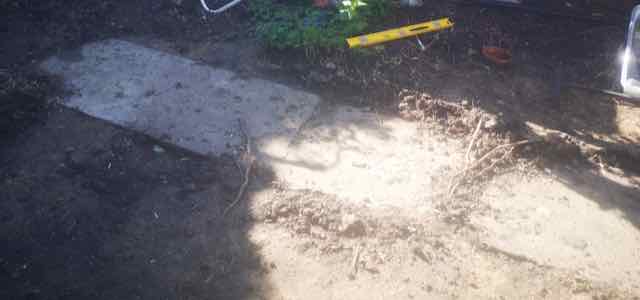
I haven’t quite decided what to do with it. I could leave it where it is, and just make sure there’s enough top soil to cover it so the lawn/meadow turf can still find water and sustenance. I could dig it up, but that would be a massive job. I’d need to bag it up and move it out.

If I could break a couple of lengths off, I could pave it and place it between the olive trees, with the garden bench on it. It could also go under the new shed. The next question would be how to move it, bearing in mind that, even as shorter slabs, it would be too heavy to lift.
I’ll think of something.
Paai: The Mat
My friend, Sree Mukundakumaran, (the woman on the left in the picture below) originated, produced, wrote, directed, funded and was the lead actor in a film called Paai: The Mat. The film is a harrowing tale of a young woman who trafficked from India into the UK, where she is pressed into work as a prostitute. It’s a remarkable piece of work of which she can be very proud. It has just been released into Amazon Prime.
For my part, I did the voice-over for the trailer, and a song of mine is used during the closing credits, sung by Katie Caserta.
What I thought of Ella Minnow Pea
I must read Ella Minnow Pea about once a year, there or thereabouts. It sits on my bookshelf, waiting patiently for me to pick it up. I browse through it while waiting for the kettle to boil or for my food to cook. I read a bit, and I’m astounded by it, as always, but then I put it back on the shelf, because I’m in the middle of something else, or I’ve only recently finished reading it and I ought to read something new before revisiting old favourites. But once in a while, I’ll sit down with it and keep reading, and I’ll see it through to the end. And it drives me nuts every time. It’s a wonderful book, wonderfully well written, but it gets me very angry.
In case you’re not familiar with it: an island state off the Carolina’s reveres a former island celebrity, Nollop, who, island wisdom has it, invented the famous pangram, ‘The quick brown fox jumps over the lazy dog’. One night, the letter Z falls from a cenotaph that commemorates the pangram. The island council decrees this is Nollop, speaking from beyond the grave, telling the people of the island that they must live without Z in their lives. A law is passed, and the people of the island duly ditch the letter Z from everything they read and say, including every book that contains words that contains it. They just on the cusp of integrating this change into all they do, when another tile falls. Then another. And so begins the disintegration of the culture, laws, and indeed the sanity, of the island.
The book is an epistolary, namely it is told through letters and notes passed between the island’s inhabitants, including the titular Ella Minnow Pea. As the story develops, and more and more tiles fall from the cenotaph, the characters have to live with less and less of a vocabulary, with all the subsequent damage it does to the way they speak, to their relationships, to their well-being, to democracy. Losing Z means losing every book in the library. Losing D means losing the past tense. Communication becomes ever harder. The penalties for using the banned letters are dramatic – first, official censure; then the stocks or the lash; then, finally, exile. And should breaches of the law continue: death! The town council become ever more self-aggrandising, taking the turmoil as an opportunity to further their own goals and feather their own nests.
Ella Minnow Pea demonstrates that making changes to society based on dogma can cause the whole thing to collapse. New believers become zealots. Chancers and charlatans operate undercover of ideology to help themselves to the hard-earned belongings of their fellow islanders. Many people leave the island, but there is never a quorum of dissenters who can find a platform to stand against them. The people of the island discover it impossible to call the council out for its insanity. Even in the face of kleptocracy and cronyism, they cannot muster the platform to bring the government down.
For Nollop, you could say Brexit. It’s exactly the same. Or austerity. Or extreme market forces. These campaigns that are forced on the nation under the guise of the will of the people, or the divine right of the supreme being, or whatever the excuse, that stomp over the norms of civil society and destroy progress, are ultimately a mechanism for greedy, vicious men to make substantial amounts of money and lord it over neighbours they never liked.
Ella Minnow Pea is a dystopian novel right up there with 1984, Brave New World and Handmaid’s Tale. It is by turns harrowing and charming, but mostly it makes me angry. Fundamentalists will get us killed, whether they are hard right, hard left, religious fervents, or whatever. If you put zealots in charge of the decisions a nation has to make, expect catastrophe.
Ella Minnow Pea is my first choice whenever asked for a fiction recommendation. And I keep coming back to it because it resonates with the times in which we’re living.
Referring to an author
Writing about Caroline Bird’s The Air Year, I realised I don’t know how to refer to the author in a review:
- Should it be surname, as if I was writing an academic treatise? ‘Bird has a way with language’. That feels a little stuffy to me.
- But then the other option, using the first name, is a bit too familiar, suggesting a friendship that I haven’t earned. ‘Caroline is a sucker for a good image’. In this case, I *think* I have friends in common with her, going by the names on the book jacket, but it would be creepy to make out there’s any connection there, because there isn’t. She wouldn’t know me if she passed me on the street. And using the first name makes it sound like there’s no dispassion there, as if I’m wrapped up in the personality of the author, and I can’t make an independent judgement.
- The other extreme, to refer to ‘the author’ throughout, would just make me look ditzy, as if I couldn’t remember who I was writing about.
(Looking back on the few reviews of my writing over the years, I was just glad they were talking about my book and saying nice things about it).
It makes me wonder about the nature of writing about books on here. They are too idiosyncratic to be proper reviews, a little bit too long form to be quick notes. Ah well, who cares. It’s nice to write a little bit about books I’ve enjoyed reading. And I’m going to keep on doing it because it’s fun.
Shazam
I love Shazam. When I’m out an about, I sit with my phone on the table, open to Shazam, ready to identify lovely songs I hadn’t come across before. Here’s a short list of songs that I heard in cafes or pubs which I previously didn’t know:
- The Creeper, Young-Holt Unlimited
- Mother Nature’s Son, Ramsay Lewis
- My Old Flame, Charlie Parker
- I’m Glad, Captain Beefheart
- Parlez-Moi D’amour, Max Steiner
- Pembe Mezarlık, Model
- Santeria, Sublime
- Engine Number 9, Wilson Pickett
- Dominoes (Fallin’ Like), Donald Byrd
- Veronica, Bert Jansch
- The Payback, James Brown
I’ll do more Shazamming on here in the future. I like it.=
May reading
Just finished:
- Exercises in Style, Raymond Queneau
- Antarctica, Clair Keegan <- course recommended reading
- Lumen, Tiffany Atkinson
- The Iron Man, Ted Hughes
- Life Studies, Robert Lowell <- course recommended reading
- The Good Ancestor, Roman Krznaric
On the go:
- Word Perfect, Susie Dent, (I’m ostensibly reading a chapter a day, but I’ve fallen way behind)
- The Nanny State Made Me, Stuart Maconie, (I keep intending to prioritise this, but always pick up something else)
- Racing Hard, Willian Fotheringham, (this is an ebook, which is a format I only read when I’m eating)
- Selected Poems, Tony Harrison, (I keep dipping in and out of this one, mainly out)
- A Taste for Death, PD James
- The Illustrated History of Football, David Squires, (I read this when I’m in the kitchen, waiting for something to boil, though the new dog takes most of my time and attention these days)
- The Crucible, Arthur Miller
- Ways of Seeing, John Berger <- course recommended reading
- First Person Singular, Haruki Murakami
Recently acquired but not started:
- The Little Black Book of Data and Democracy, Kyle Taylor
- Ambit Pop
- The Unfolding of Language, Guy Deutscher
- The Unaccompanied, Simon Armitage
- The Ministry for the Future, Kim Stanley Robinson
Garden to-do list
Here’s a list of things I need to do in the garden:
Shed
- buy a new drill bit to pre-drill the screw holes
- build the shed
- fasten it in place
- treat it
- fill it with tools, paint, etc
Removing rubbish
- the old fence
- the rubbish at the front of the house
- 130 flags
- the 150 rubble sacks filled with rubble
- a chest of drawers
- the old garden table and chairs
Fixing the side fence
- replacing the slat that fell off
- screwing the slats in place
- treating it
- painting the base white
Laying the garden path
- buying the pavers and cement
- laying the pavers
- deciding what to do about the drain covers
- deciding what to do about the path through the lawn
Summerhouse
- replace the felt on the roof that has come away
- treat it inside
- get the electrics looked at
- take the masking tape from the windows
Bench
- sort out the base for the bench
- paint the metalwork
- paint the woodwork
Turf
- buy the turf
- buy the top soil
- spread the top soil
- lay the turf
Too many projects
I’m shocking at not finishing projects. Big projects, small projects: I’ll get three-quarters of the way through, then get distracted by something else.
At the moment, I have about six or seven projects on the go:
Writing projects
- Writing the short story, Scholar’s Mate
- Writing the short story, Maria Moxon’s Little Problem
- Writing the short story, The Day Stephen Farrell Became Available
- Writing the short story, The Hospice
- Editing the novel, Super-8
- Editing the radio play, The Pending Apocalypse
Home projects
- Doing up the garden
They’re all projects I want to get finished by the back end of the summer, to get them out of the way before I begin my course. The short stories all combine to form the basis of a novel, along with a final, long-form piece which will bring them all together, and will serve as my end of course writing project. The long-form piece will teach me things about the content of the short stories which I will need to feed back into the text, so the short stories won’t be finished until the whole novel is finished.
In that sense, there’s no immediate hurry. It’s only the start of June. None of them are more important than the others, necessarily. But while I’m working on any given piece, I’m not working on any of the others, and that’s frustrating. There are only so many hours in the day.
I know what I should do: I should pick one and finish it. Pick another and finish it. Pick another and finish it. This is one of the things I want from the course, a sense of priority, even if the priority is arbitrary.
Digging up the flags
I’ve disliked these flags ever since we bought this house. Once I’d decided on building a meadow, I had the joyous decision that the flags were going to go. And then the dread that no one else was going to have to move them except me.
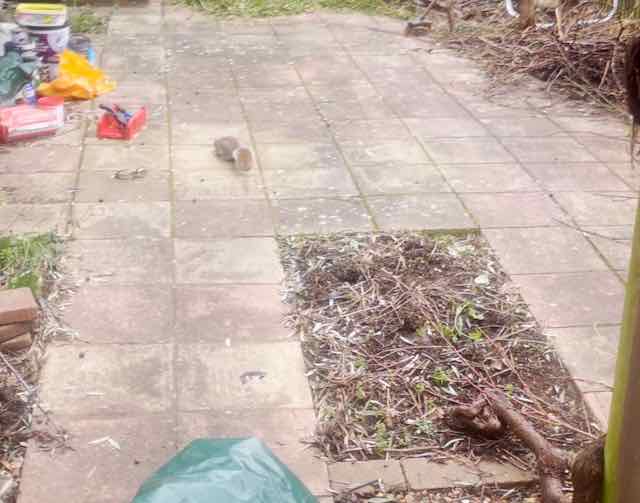
Beneath them, is about 6 to 9 inches of concrete, in various stages of disintegration. Beneath that, soil that hasn’t seen the light of day for at least twenty years, more likely closer to fifty.
So I’ve been working my way through it, ten flags per day. Lifting the flags is the easy bit.

Hacking the concrete away is the tough bit.
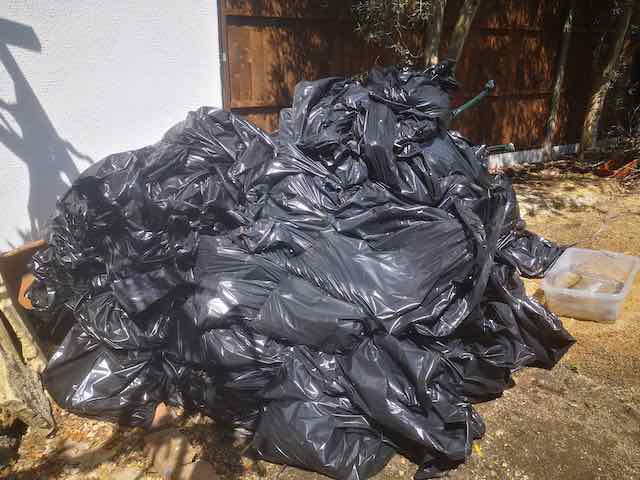
And then bagging it all up. I think there’s 150 bags worth of rubble. At some point, I have to take all this to the tip.
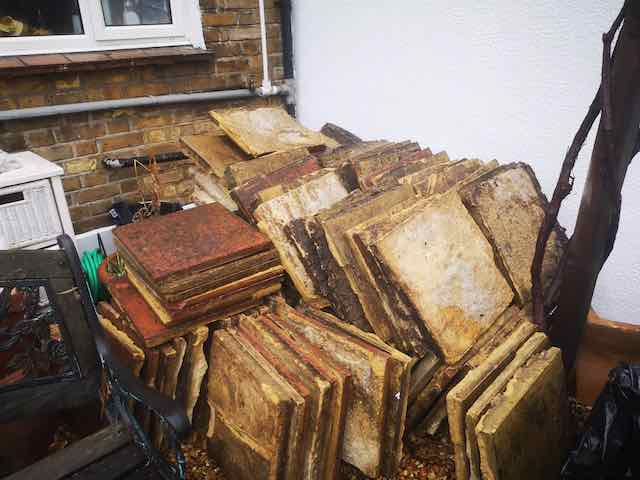
Here’re all the flags, all in pile.

But here’s the end product of all this work, soil. The garden is almost a foot lower in parts, which I think’s OK. I’m hoping it creates an optical illusion to make the garden look longer.
What I thought of The Air Year
Caroline Bird’s The Air Year is a lovely book.
It’s her fourth collection of poems. The only collection of hers I’d previously dipped into was read standing up beside the poetry section in Foyles at Waterloo station in the months between the first and second lockdowns. I zoomed through three of four poems, liked them, then put it back on the shelf and bought something else, (Ted Hughes’ Crow, if I recall correctly, which was half magnificent, half a clunky mess).

Somewhere on the train home, (possibly changing at Clapham Junction), I realised I regretted ditching the Bird book. In January, on a shopping spree to bag all the books I hadn’t received for Christmas, (I did very nicely but there’s always another book to buy!) I casually dropped The Air Year into my shopping cart and, the following day, the paperback casually dropped through my letter box.
The Air Year is as good as I hoped it would be. It’s exuberant, thought-provoking, moving, fun. The writing is deft, lively, witty. I can’t recall a duff poem in the whole collection. This is from the first poem, Mid-air:
… If kisses were scored by composers
they’d place the breath on the upbeat. Oh
God. Music preceded by mid-air,
when the baton lifts…
This is from a poem called Speechless:
… but tonight all the words left
the house in their thinnest summer
jackets, despite the December cold, they strutted
out with barely a stitch on …
I always enjoy reading about writing, those times when the author takes a step back and thinks about the nature of what we do as authors. We create strange little marks on paper that utilise a weird and arbitrary code that builds from letters to words to sentences to paragraphs, drafting in odd little scratches to signify where one thought ends and the next begins. As a system, it’s bonkers. How did we get here, these vast assumptions and collective decisions that have been layered up over the years to represent, recognise and interpret patterns of light and sound? It’s astonishing, yet we rely on it for practically everything we do in life and we take it for granted. Now and again, an author will address the concept of communicating through words, and that adds an extra layer of significance to the symbols that are laid out before us.
Anyway, returning to the matter in hand, the title The Air Year refers to the first year of a relationship or marriage, where the couple hasn’t reached the landmark of the paper anniversary. That sense that the relationship is going somewhere, but it hasn’t got the years under its belt to demonstrate longevity or seriousness. I don’t know if the Air Year is an existing concept or a bit of fun dreamed up by Ms Bird and her partner. I’m not too worried, either way. It’s a nice concept, and I hadn’t come across it before, so I’ll always associate it with this collection.
Creative Writing
I’ve been accepted onto the MA in Creative Writing at Birkbeck. I’m thrilled.
I’ll be studying part-time over two years, as I need to earn a living. It’ll be a bit of a stretch to fit it all in. Never mind, I’ll manage.
I’ve been writing for forty years. The first thing I wrote was a poem to fulfil an assignment for my English Language 16+ when I was 15. I wrote it because I could see my pals playing football in the school field that abutted our house, and I wanted to be out there with them, but my mum had laid the law down for once that I couldn’t play until I’d finished my assignment. I figured a poem would be quick to write, so I chucked something down and was out of the house fifteen minutes later. My English teacher commented, as she returned the piece, ‘You like writing, don’t you’ , and I thought, ‘Yes, I do’. And since then, I’ve done quite a lot of it.
But in forty years, I can’t say I’ve got anywhere. There are certain things I’ve achieved that I’m proud of – my two books of poems, my novel, the two poems in The Blizzard, for example – but I haven’t made a name for myself, or been consistently published, or established a working relationship with a publisher, or picked up an agent. It’s not that I’m still on Square One but, if we’re talking snakes and ladders, I’m still on that bottom row, and nothing I’ve done has raised me higher up for long. I keep slipping back down.
If I’m a decent writer, as I think I am, then I have underachieved. Now, I am absolutely sure that this is my fault and my fault alone. In that sense, I have failed myself.
For a start, I leap around from one piece to another, from one genre to another, never quite finishing anything, never building up a body of work in a specific field that would draw the attention of a commissioning editor, say, in crime or in poetry, to make them think that my writing is worth gambling their budget on. (Commercial publishing is gambling. Publishers bet money that a given author will create a product in a year’s time that will make the publisher a liveable profit within three years).
I work as a Managing Editor of a team of Commissioning Editors. I know first hand that it’s not easy to select potential authors from the thousands that are out there, desperate to be published. As an author, I haven’t made it easy for them. I don’t have a core following who would be certain to buy my books, which would mitigate the risk of investment. I don’t have a track record of astounding publications which have set the public alight, which would reassure a prevaricating editor. This in an age when commissioning houses are losing staff at a frightening rate, where editorial staff are being cut, and marketing budgets are being slashed in an attempt to balance the books. And we can sulk about this lack of investment in our cultural life but, if I were on the Board of a publisher, seeing our profits dwindle year on year, I’d probably slash budgets, too, even though it’s a self-fulfilling prophecy that sales will naturally disappoint if the public are unaware that a given book is available for purchase.
So, after forty years, I needed to do something. And that’s when I started to look into the MA. It’s not an instant panacea to the systemic problems of my lack of a personal publishing strategy, but it’s an important step. My plan is to use it to realign my mindset, to switch from being a good amateur writer to being a good professional writer. That means ensuring everything I create has a purpose, that I finish things, that I meet deadlines (even if they are set by myself), and that I build my confidence that my writing has value for a publisher.
I start the course in late-September. I’m already working my way through the reading list.
Reading poetry
Something that I noticed the other week that took me by surprise: I read poetry in a different way to prose.
A novel, a short story, a piece of prose, I’ll read once through, and presume I’ve got the gist of what the author meant and how he or she wanted to say it. I might come back to a novel in a few years time if it got under my skin or if I want to experience it again, but the whole thing is absorbed in one massive inhalation.
Poetry is different. By its nature, it’s more intense. I read each poem twice. The first time through is to familiarise myself with its structure and pattern, so the second time through I can understand it a bit better, get to grips with the narrative, take in the imagery, and hopefully enjoy it. It takes a couple of readings for all the elements of the poem to interact, so it can make me think or dream or let me stand in someone else’s shoes.
In that sense, a book of poems isn’t a quick read. It’s easy to dip in and out, but reading a collection can be a long haul.
I rarely go back to poetry. Frank O’Hara’s Lunch Poems and Ginsburg’s Howl are perhaps the only ones I can think of. Maybe Zoom. Oh, and Autumn Journal. Otherwise, once I’ve read it, it goes on my bookshelf, to look nice but rarely to be read again.
Ruth
Another glimpse at a character from Investing in the Afterlife, Inc.:
Their leader was Ruth. She dressed like the world’s worst dominatrix attending a business lunch. Her hair was High Street by way of a privet hedge and, around her neck, she wore a thick, thick chain, as if she’d snuck away from a chain-gang to return a whip to the boss man, or as if she were pre-paying a penance for something wicked she was bound to do in the future.
Goss ran his eye over Ruth and wasn’t attracted to her, which made it easier to do business. She was ripe for being took. If you needed a captain of a vessel to go down with the ship, she was the one willing to steer the thing onto the iceberg. She was just competent enough to plot a course for the iceberg, to arrange the band to play a rousing chorus as the hull was breeched, to ensure the right people got a lifeboat while below deck the chefs cooked them a delicious meal to take with them. She was crashing into the iceberg for the benefit of all, because at some point that’s what everyone had agreed, kind of, and she would see it through, regardless. Someone somewhere had clearly stated that they wanted her to sink the ship. They’d voted for it, sort of. And damn it, she was going to give them what they asked for. She was perfectly capable of dying for the cause and taking the whole cause down with her to show her commitment.
And Goss was perfectly capable of ensuring she paid for the privilege.
April Reading
Just finished:
- In Praise of Men and Other People, Ann Sansom
- Come Closer and Listen, Charles Simic
- Exit Management, Naomi Booth
On the go:
- Word Perfect, Susie Dent, (reading a chapter a day, but I’m falling behind)
- The Nanny State Made Me, Stuart Maconie, (I keep intending to prioritise this, but always pick up something else)
- Racing Hard, Willian Fotheringham, (this is an ebook, which I only tend to read when I’m eating)
- Selected Poems, Tony Harrison, (I keep dipping in and out of this one, mainly out)
- A Taste for Death, PD James
- The Good Ancestor, Roman Krznaric
- The Illustrated History of Football, David Squires, (I read this when I’m in the kitchen, waiting for something to boil, though the new dog takes most of my time and attention these days)
- The Crucible, Arthur Miller
- Exercises in Style, Raymond Queneau
- Antarctica, Clair Keegan
Recently acquired but not started:
- The Secret Barrister, (I’d already got it)
- The Creative Writing Coursebook, ed Julia Bell and Paul Magrs
- The Echo Chamber, Luke Williams
- Ways of Seeing, John Berger
- First Person Singular, Haruki Murakami (this was bought for me. I’m a bit of a Murakami completist)
- Life Studies, Robert Lowell
Bought for my wife for Mother’s Day, only to find it was the wrong Mother’s Day:
- Ruth Baden Ginsberg, Jane Sherron De Hart
New compost heap
I needed a new compost heap. Something that looked nice, and didn’t look like a massive block of plastic at the end of the garden. I went for a bee hive design. Here it is as it arrived:

And here it is built.

I’m keeping the old one. The new one will be vegetables, grass cuttings, etc. The old one will be where I put switches from the plum tree and olive tree, the stuff that’s a little harder to break down.
New fence
I didn’t know, till we bought a house in a terrace, that a householder is responsible for the border fence to the left of the property as they look out.
Fair enough. Except that our fence on that side had rotted and was drooping into next door’s garden. Our neighbours (Holly and Roger) are lovely, and they were very nicer about it, but the imperative to sort the fence out grew with every windy day. They’re expecting their first child, so wanted to do what they could to prepare the house. They offered to help me replace the fence, which was kind of them; they had no obligation to do that. But it was a way of making sure it got done, and that it got done properly. They’d built an equivalent fence on the other side of their property, so they knew what they doing and had acquired the requisite tools. As with anything, with the right tools, the job becomes considerably easier.
We spent a Saturday doing the work. We ripped the old fence down the evening before, then set to on Saturday morning. We were finished in time for Roger to watch the Grand National at five. Roger called the shots. I was his willing grafter, and while Roger did the technical stuff, I spent my time breaking the old fence down and ripping the nails out to make sure the dog didn’t tread on them.
So here it is, the work done. I love it. I love the battens. I thought I’d hate the concrete posts, but they look tidy.

Jerome
Another character study from Investing in the Afterlife, Inc.:
On Basil’s right sat tall, corporate, gangly, self-gratified Jerome, with a little first aid kit tucked under his arm. He was a cynical free market ideologue who believed everyone had a duty to pay whatever price he asked for whatever services he provided. Every person, every service, every product, every benefit, every feature, every living thing stood independent of the rest. He would happily believe in Society if only he could flog it but, in the absence of an over-arching price tag for the entire job lot, he preferred to chop the world into its component parts and sell it off, bit by bit.
To Jerome, children were a luxury you chose to invest in. Love was a corporate coming-together of financial muscle. Art was a pretty design to excuse an elevated price point. Death was a creative accounting opportunity. Nature was a warehouse doling out gratis commodities. Life was to buy and to sell, much as he hoped he could entice Goss to invest in the right to stock his new line of first aid kits.
Doing up the garden
I’m on a garden regeneration kick. This is what it looked like at the start of the year:

It wasn’t horrible, by any means, but it could be nicer.
- The fence on the left is on the point of the collapse, (so’s the fence on the right, but that’s not the fence we’re responsible for).
- The flags look like they were designed using Minecraft, in big clunky blocks.
- The lavender piled up on the right was dug up from the bed on the left. A fungus had rotted the roots.
- The summerhouse needs care and attention. The felt came away, so the rain is getting in, and the weather-proof paint is flaking. Plus we’re using it to store tools, paint and chairs that we don’t want in the house, so we can’t sit within it to enjoy the last of the evening’s sun.
- The flowers I planted ten years ago are looking shabbier ever year.
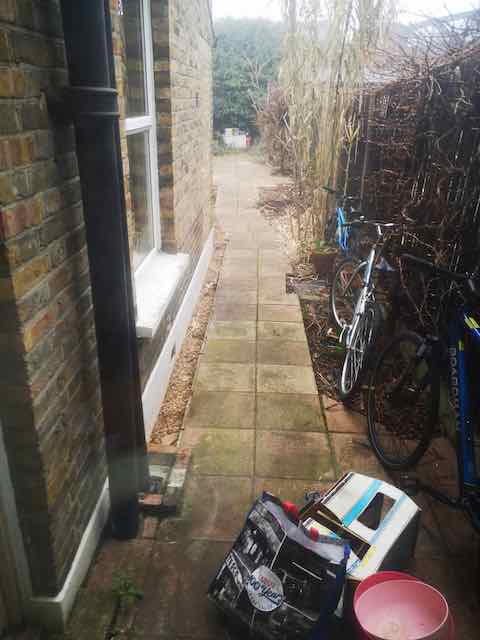
Overall, it needs some time and attention. I’d given it a massive overhaul ten years ago, pulling up tons of flags and concrete, and a breeze block pen at the far end, which the infirmed lady who owned the house before us had had constructed so she could do a little bit of gardening without distressing her legs. I’d planted grapevines, an apple tree, two olive trees, a plum tree, bamboo, a pear tree, nectarine, jasmine, clematis, honeysuckle, and hydrangea. Practically everything I planted grew. But since the boy came along, I haven’t had chance to get out there and do much more than weed and lop off a few stray switches. It’s gotten a bit raggedy.
Chatting with the neighbours on the left, (we have nice neighbours both sides, which is a relief), they were concerned about the way the fence was sagging into their garden. They’d installed a new fence on side away from us, which looked nice, and the price they’d paid for materials wasn’t completely out of my price range. So we came to an arrangement where I would pay for a new fence and he (Roger) would help me build it.
There were lots of things I didn’t like about the garden, beyond the bits that were falling down.
- The trees sequester carbon, but the flags don’t.
- I want to look out of my back window and see GREEN!
- I’ve never really loved the flags. Tolerated, but not loved.
- We’re not really doing much for pollinators except at the height of summer.
- The garden isn’t really somewhere I want to sit of an evening.
Once the idea of putting time and effort into the garden got lodged in my brain, I started thinking about the ways I’d like to change it. Primarily, I want to lay down a meadow to allow bees and butterflies to feed from Spring to Autumn.
So that’s the plan.
This is a list of books on my bookshelf that, some time soon, I will read:
- On Cricket, Mike Brearley
- The Monuments, Peter Cousins
- Racing Hard, William Fotheringham
- Remain in Love: Talking Heads, Tom Tom Club, Tina, Chris Frantz
- Coal Black Mornings, Brett Anderson
- Afternoons with the Blinds Drawn, Brett Anderson
- This Is Your Brain On Music, Daniel Levitin
- Electronic Music Travels, Martin Christie
- Sounds Like London, Lloyd Bradley
- Chapter and Verse: Joy Division, New Order and Me, Bernard Sumner
- Cowboys and Indies, Gareth Murphy
- The Last Man in Russia, Oliver Bullough
- Doughnut Economics, Kate Raworth
- Winning the Green New Deal, Varshini Prakash and Guido Gergenti
- Democracy for Sale, Peter Geoghegan
- The Good Ancestor, Roman Krznaric
- Mindf*ck, Christopher Wylie
- Who Owns England, Guy Shrubsole
- Keep the Aspidistras Flying, George Orwell
- Shadow State, Luke Harding
- The Pigeon Tunnel, John Le Carre
- Long Road From Jarrow, Stuart Maconie
- Wampeters, Foma and Granfaloons, Kurt Vonnegut
- God Bless You, Dr Kevokian, Kurt Vonnegut
- Sudden Traveller, Sarah Hall
- Paterson, William Carlos Williams
- Creating a Culture of Innovation, Alexandra Deschamps-Sonsino
- Forensics, Val McDermid
- The Science of Storytelling, Will Storr
 Clattermonger